


The palace standing on Ferenciek Square is the first building in the country that was built specifically for the purpose of storing books. Its construction began in the year the city was unified, and the official opening ceremony was held on March 26, 1876.
The creation of the library collection is linked to the name of Miklós Oláh, Archbishop of Esztergom, who founded the Jesuit college in Nagyszombat in 1561: this later became the foundation of the university library established by Péter Pázmány. After Pope Clement XIV dissolved the Jesuit order in 1773, Maria Theresa entrusted Farkas Kempelen with the task of relocating the royal university, which already existed by then, to Buda, in the Castle, in 1780.
The transfer of the library holdings, consisting of more than 15,000 volumes, took two and a half months, but in 1784 the collection had to be moved again, this time to the Pest side. In the former Franciscan monastery on today’s Ferenciek Square (then Barátok Square), the book collections of the other dissolved monastic orders (Cistercians, Dominicans, Franciscans, Capuchins, Premonstratensians, Paulines, Servites, Camaldolese, Trinitarians) were also added to the holdings, so they grew to a vast size, about twenty-two thousand volumes.
However, the Pest building was far from suitable for storing books. The idea of a new building suitable for the collection emerged in the 1840s, but actual construction work was postponed due to the War of Independence. Construction finally began successfully in 1873, and during the foundation work, a Roman-era stone, an entrance keystone with the Hunyadi coat-of-arms, and a column capital from King Matthias’s palace were unearthed. Library director Ferenc Toldy donated these to the National Museum, asking in return for book rarities from the museum’s collection.
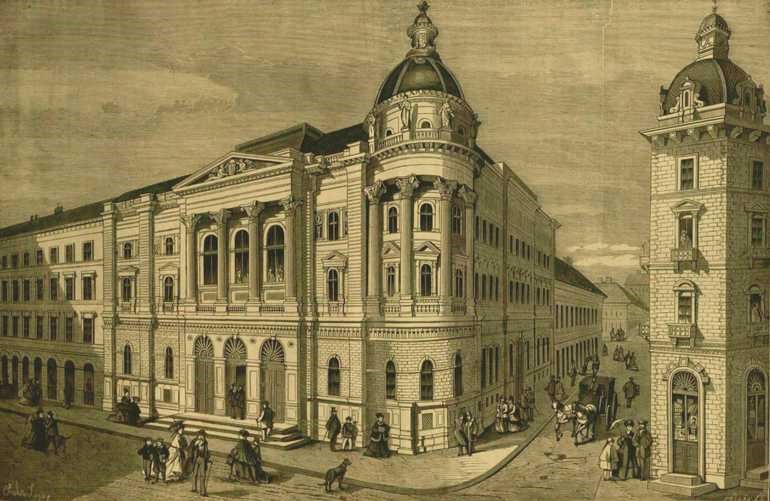
The University Library building (Source: Vasárnapi Ujság, January 24, 1875)
The topping out ceremony of the building was held on October 26, 1873, when construction work reached the height of the cornice. The workers decorated the walls as per tradition, and wrote on a large banner the names of those to whom the creation of the building was owed. Its designer was the young Antal Szkalnitzky, who envisioned the historicist-style library palace as a true work of total art: the reading room is adorned with frescoes by Károly Lotz, and the sgraffito on the facade was created by Mór Than.
The building was completed on March 26, 1876. At first, the reading room was only open during daylight, as there were long-standing fears about the dangers of introducing gas and electric lighting. The 15-meter-high ceremonial hall is decorated with Károly Lotz’s allegorical frescoes depicting sciences and arts, while the portrait of Franz Joseph and the facade sgraffito also bear witness to Mór Than’s artistry.
The library quickly outgrew the building, students often queued to enter the reading rooms, and new shelves had to be placed in front of the bookcases because the collection would no longer fit on the shelves. However, the number of reading places did not increase, so there were times during exam periods when only university students could use the library.
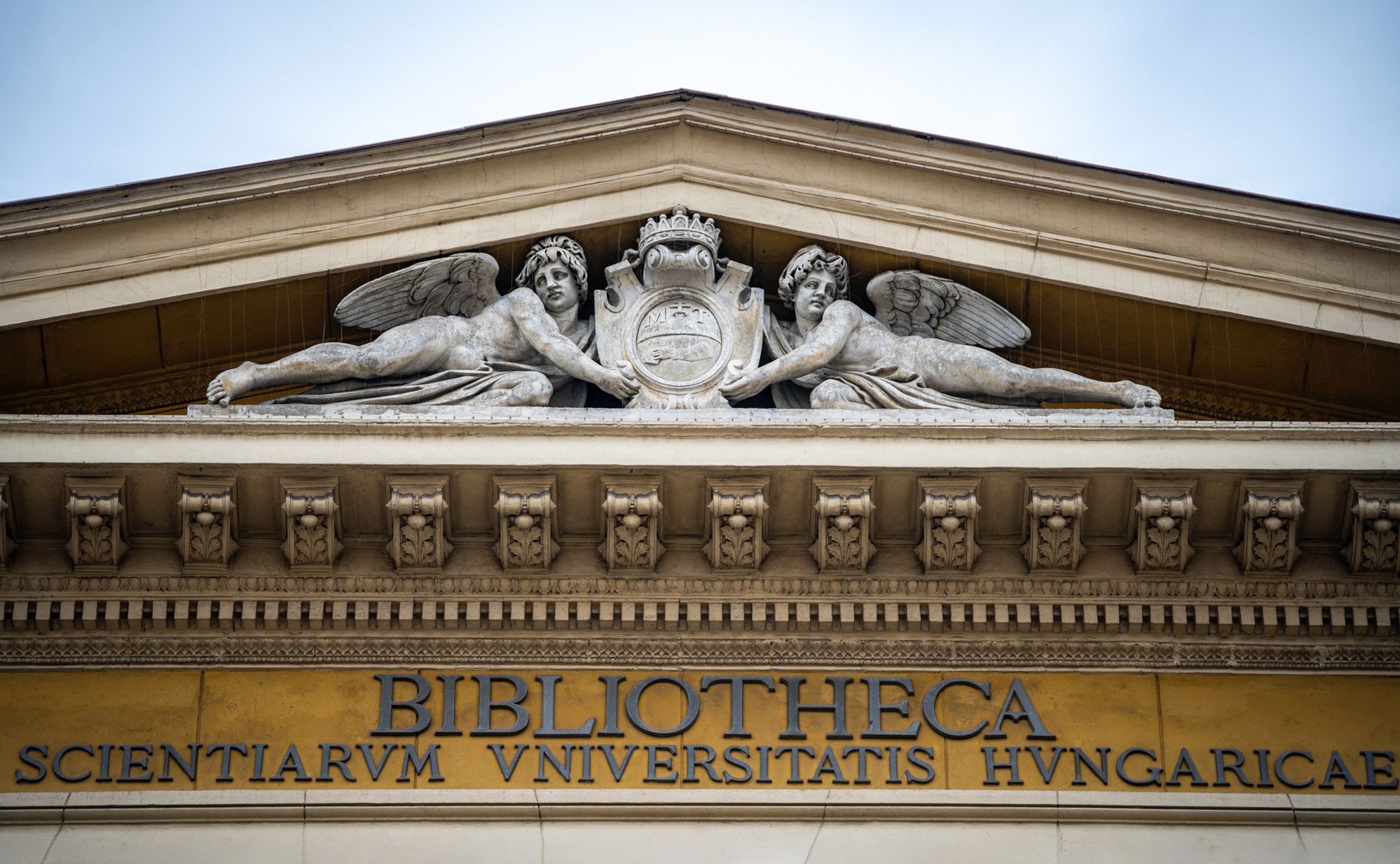
On top of the facade of the building, two angels hold the crest of the University of Pest, below it the inscription: Bibliotheca scientiarum universitatis hungaricae, that is, 'Library of the Hungarian University of Sciences' (Photo: Balázs Both / pestbuda.hu)
During the construction of Metro line 3 in 1974, cracks appeared in several places in the building, the palace subsided, and the glass roof shifted. Renovation work was completed in 1999, but the four statues that originally stood by the dome unfortunately are still not visible on the facade today.
The University Library and Archives, which opened on March 26, 1876—exactly 145 years ago—now functions as a scientific institution, a specialist library, and a public library. It preserves the country’s second largest collection of antiquities, after the National Széchényi Library. Its four main collection areas are: philosophy, psychology, medieval history, and history of religion. Along with preserving traditions, the institution is constantly striving to modernize the library system and digitize its holdings.
In January 2021, on the occasion of the Day of Hungarian Culture, a short film was made about the library, presenting areas of the building that are normally closed to visitors.
Source: pestbuda.hu
Cover photo source: Balázs Both / pestbuda.hu