


A Hungarian research team has proposed a new cosmological framework in which the observed accelerated expansion of the Universe emerges without invoking dark energy. The model suggests that the effect usually attributed to dark energy may instead arise from the combined dynamics of matter and spatial curvature. The framework may also help resolve the so-called Hubble tension, a mismatch in measurements of the Universe’s current expansion rate.
Smartphone displays produce every color using just three kinds of pixels: red, green, and blue. Yellow, for example, appears when red and green light are combined. The researchers suggest that a similar mechanism may operate in cosmology.
"What we interpret as dark energy may be analogous to a ‘composite color’," says Dr. Peter Raffai, associate professor at ELTE Eötvös Loránd University. "It could emerge from the interplay of known physical ingredients — matter and spatial curvature — rather than requiring a fundamentally new component. In that sense, searching for dark energy might be like looking for yellow pixels on a screen displaying sunflowers."
The current standard cosmological paradigm, the Lambda Cold Dark Matter (LCDM) model, assumes that the Universe is homogeneous and isotropic on large scales. Within this framework, cosmic expansion was initially slowed by matter, until a cosmological-constant–like component — dark energy — began driving accelerated expansion about 5–6 billion years ago. While LCDM successfully explains a wide range of observations, the physical nature of dark energy remains unknown.
Moreover, the model faces a significant internal inconsistency known as the Hubble tension: different observational methods yield incompatible values for the present expansion rate of the Universe, the Hubble constant. This discrepancy has reached high statistical significance and is unlikely to be explained by simple systematics.
Volume-Dominating Inhomogeneity
The new study argues that the apparent need for dark energy may stem from the assumption that a single, uniform expansion applies across all scales. The Universe may instead expand at different rates in different regions whose combined expansion determines the global dynamics.
"Our work provides a kind of ‘mixing recipe’," explains Dr. Raffai, lead author. "Different regions can have different matter densities and spatial curvatures, and when their evolution is combined, the result mimics the effect usually attributed to dark energy."
In this picture, these regions need not fill the entire Universe seamlessly; it suffices that they dominate the cosmic volume. Overdense, positively curved regions expand more slowly, while underdense, negatively curved regions expand more rapidly and progressively occupy a larger fraction of space.
"As these underdense regions come to dominate, the average spatial curvature becomes increasingly negative," says Dr. Raffai. "This is fundamentally different from standard homogeneous models, where curvature is fixed and cannot evolve in this way."
Accelerated Expansion Without Dark Energy
A Universe with constant negative curvature expands at a uniform rate once matter has sufficiently diluted. However, if spatial curvature becomes progressively more negative over time, the global expansion can enter a phase of acceleration — without introducing dark energy. Importantly, this accelerated phase is transient, and the model asymptotically approaches uniform expansion.
"Such a Universe would not possess a permanently impenetrable event horizon," adds Dr. Raffai. "In principle, no region would remain forever causally inaccessible."
Observational Consistency
The model — an inhomogeneous Einstein–de Sitter (iEdS) cosmology — reproduces the standard early-Universe physics of LCDM during the epoch when the Universe was nearly homogeneous. The formation of the cosmic microwave background (CMB), primordial nucleosynthesis, and cosmic inflation proceed as in the conventional scenario.
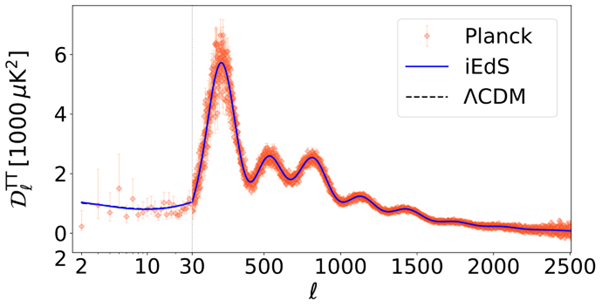
Measurements of the cosmic microwave background by the Planck satellite (orange) compared with predictions of the standard cosmological model (black dashed) and the new iEdS model (blue). The two curves are virtually indistinguishable, demonstrating that the new model matches one of cosmology’s most precise observations as closely as the conventional dark-energy framework, with a Hubble constant of 72.5 km s⁻¹ Mpc⁻¹ consistent with Type Ia supernova measurements. [Credit: Raffai et al. 2026]
At later times, however, the model simultaneously accounts for CMB observations, baryon acoustic oscillations, and Type Ia supernova data, while naturally resolving the Hubble tension. The predicted age of the Universe is 13.67 billion years — approximately 1% younger than the standard LCDM estimate — remaining consistent with expansion-independent age constraints.
"What is striking is that a simple and physically plausible mixing rule reproduces the key observations,” says Dr. Raffai. "At the same time, the apparent contradiction between different measurements of the Hubble constant disappears if cosmic expansion is interpreted as arising from a patchy, spatially varying structure rather than from a uniform dark-energy component."
Publication and Outlook
The work, led by Dr. Peter Raffai of ELTE Eötvös Loránd University, has been published in Physical Review D following peer review. Further theoretical and observational tests will be required to determine whether the inhomogeneous Einstein–de Sitter framework can serve as a viable alternative to dark energy–based cosmology.
The research was supported by the HUN-REN Hungarian Research Network and the National Research, Development and Innovation Office through the Thematic Excellence Programme (TKP2021-NKTA-64).
Publication details:
Raffai, P., Kis, D. E. R., Ködmön, D. A., Pataki, A., Böttger, R. L., Dálya, G.; "Case for an Inhomogeneous Einstein-de Sitter Universe", Phys. Rev. D 113, 063553 (2026) DOI: https://doi.org/10.1103/rm7t-8ksp