


One of the leaders of the project that has been awarded a €10 million grant to study the early medieval population of Europe is Tivadar Vida, professor of archaeology at ELTE.
The aim of the project titled “Integrating genetic, archaeological and historical perspectives on Eastern Central Europe, 400–900 AD (HistoGenes),” which won support from the most prestigious funding scheme of the European Research Council (ERC) - the Synergy Grant, is to gain a deeper understanding of the population history of Eastern Central Europe after the fall of the Roman Empire, during the period of the great migrations and the early medieval political and cultural changes. One of the leaders of the international project is Tivadar Vida, director of the Institute of Archaeological Sciences at ELTE.
This is a significant achievement for Hungarian archaeology, archaeogenetics, anthropology, and history: an ambitious program can begin, within the framework of international cooperation, with an investment of about €10 million, lasting six years, focusing on the integrative paleogenetic, archaeological, anthropological, and historical study of Late Antique and Early Medieval populations in Eastern Central Europe (HistoGenes 856453). Researchers from the ELTE Faculty of Humanities, Institute of Archaeological Sciences and the Archaeological Institute of the Research Centre for the Humanities (an Excellence Research Site of the Hungarian Academy of Sciences) will play key roles in this international program, which brings together Austrian, German, American, and Hungarian researchers. Research teams from the Hungarian National Museum, the University of Szeged, and the Natural History Museum in Hungary are also participating in the research.
Today, historical genetic research has become relevant to the period of migrations and the Early Middle Ages as well. In recent years
there have been spectacular advances in the study of ancient DNA,
which now, through a multidisciplinary approach, enables the exploration of connections and differences between communities and groups at both macro and micro levels. This is particularly interesting in the early Middle Ages (4th–9th centuries AD), when various barbarian groups (Goths, Vandals, Franks, etc.) migrating into the territories of the disintegrating Western Roman Empire established their own independent kingdoms—signifying both the dissolution and transformation of old political and cultural formations, as well as the emergence of new ones.
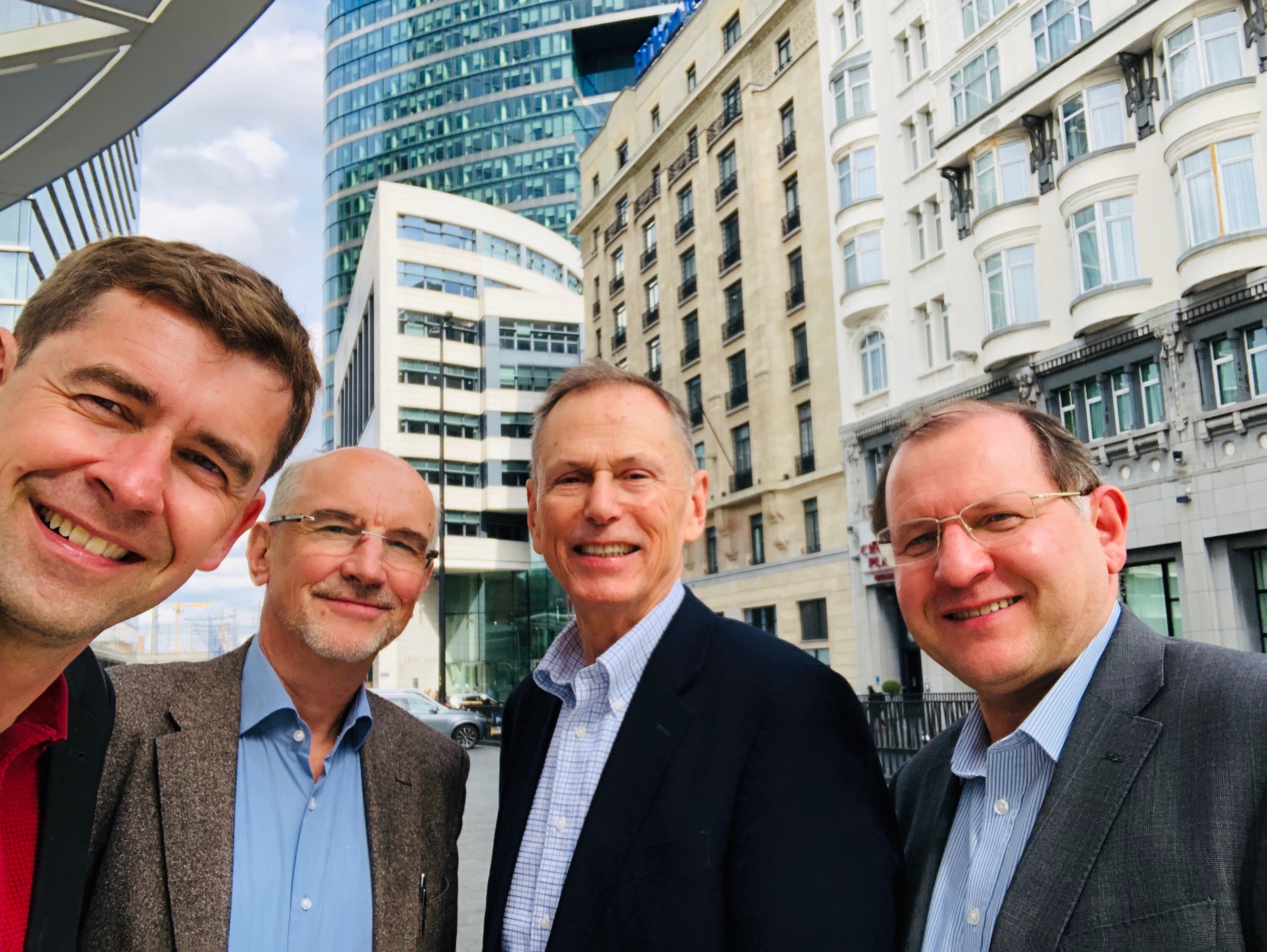
From left to right: Johannes Krause (PI), Max Planck Institute for the Science of Human History, Jena; Walter Pohl (cPI), Institute of Medieval Research, Austrian Academy of Sciences, Vienna; Patrick J. Geary (PI), Institute for Advanced Study, Princeton, USA; Tivadar Vida (PI) Institute of Archaeological Sciences, ELTE-Eötvös Loránd University
The planned research is unique not only in scale but also novel in its approach. Previous, primarily prehistoric paleogenetic studies have focused on long-term, population-wide processes (mixing and migration of groups). The core international research group of the project was the first to attempt paleogenetic (complemented with Sr-, C-, N-, and O-isotope) analysis of entire cemeteries, enabling answers to questions that had previously been beyond the scope of archaeology (see the publication about this in Nature, available here). The starting point is understanding the individual's biological status (DNA, health, age, diet) and social position. At the next level, the organization of local communities made up of individuals (e.g., kinship, family, household) and their archaeologically observed cultural and social representation can be defined. Broadening the research in space allows for conclusions about relationships between communities, while the temporal perspective, through the inclusion of historical sources, also enables long-term multidisciplinary population historical analysis. It is important to highlight that
written sources are already available for this period,
which reflect on all the questions raised by archaeology and genetics (organization of communities, social hierarchy, ethnicity, lifestyle, war, violence, working conditions, etc.), making it a particularly interesting challenge to compare and integrate the results with these sources.
The synergy of the included disciplines is achieved by jointly evaluating results from molecular biology (DNA), isotope chemistry, archaeology, bioinformatics, physical anthropology, and historical research, but the research also draws from the tools of other fields—cultural anthropology, ethnography, sociology, psychology, network analysis, etc.
Within the project, it will be possible to conduct paleogenetic analysis of around 6,000 burials and human samples from Hungary, Germany, Austria, the Czech Republic, Slovakia, Romania, Serbia, Croatia, and Slovenia. Achieving the project’s objectives over this vast area is only possible with an extensive research network comprising local archaeologists, anthropologists, geneticists, and historians.
The archaeological analysis is coordinated by the ELTE research group.
The project allows for the employment of PhD students and the involvement of university students in the workflow.
ABOUT THE PARTICIPANTS
Leaders and key partners of the international research group:
Walter Pohl (cPI), Institute of Medieval Research, Austrian Academy of Sciences, Vienna;
Patrick J. Geary (PI), Institute for Advanced Study, Princeton, USA;
Johannes Krause (PI), Max Planck Institute for the Science of Human History, Jena;
Tivadar Vida (PI) Institute of Archaeological Sciences, Eötvös Loránd University, Budapest.
The Archaeogenetics Laboratory of the Archaeological Institute of the Research Centre for the Humanities (an Excellence Research Site of the Hungarian Academy of Sciences), which operates within the Eötvös Loránd Research Network, is participating in the project as a partner beneficiary of ELTE, with staff: Anna Szécsényi-Nagy, head of the laboratory and archaeogeneticist, and Gusztáv Balázs Mende, anthropologist and group leader. The laboratory is responsible for preparing genetic samples and also for the analysis and examination of samples from Hungary. Also a beneficiary partner is Corina Knipper from Curt-Engelhorn-Zentrum Archäometrie GmbH, Mannheim, who leads isotope research on mobility and diet.
Members of the ELTE research group: Zsófia Rácz, István Koncz, Levente Samu, Bence Gulyás (archaeologists), Tamás Hajdu, Tamás Szeniczey (anthropologists). Members of the Research Centre for the Humanities (an Excellence Research Site of the Hungarian Academy of Sciences) research group: Ádám Bollók, Gergely Csiky, Béla Miklós Szőke (archaeologists), Veronika Csáky, Dániel Gerber (geneticists). Members of the Hungarian National Museum research group: Gergely Szenthe, Zsuzsanna Hajnal. Members of the University of Szeged research group: Erika Molnár, György Pálfi, Antónia Marcsik. Members of the Natural History Museum research group: Zsolt Bernert, Ildikó Pap. Heads of national research groups: Tina Milavec (University of Ljubljana), Vujadin M. Ivanišević, Nataša Miladinović-Radmilović (Institute of Archaeology, Belgrade), Matej Ruttkay (Archaeological Institute of the Slovak Academy of Sciences, Nitra), Lumír Poláček (Institute of Archaeology of the Czech Academy of Sciences, Brno). Head of the Romanian research group: Szilárd Gál (Marosvásárhely Museum). Head of the German research group: Daniel Winger (University of Rostock).
Hungarian scientific advisers to the project: Csanád Bálint, Elek Benkő, László Borhy (members of the Academy).
PREVIOUS ARTICLES ON TIVADAR VIDA’S RESEARCH:
The winning project was selected in a category that stands out even among the most prestigious basic research grants in the EU: the so-called ERC Synergy Grant. The European Research Council first announced the Synergy Grant in 2012 and 2013 as a pilot, and then, after four years of careful preparation, launched the next call in 2017. Synergy Grants help facilitate collaboration between different scientific fields, in order to lay the foundations for new research areas through their combined results. In 2018, a similar grant was awarded to László Lovász, president of the Hungarian Academy of Sciences, Albert-László Barabási (CEU) and Czech researcher Jaroslav Nešetřil (Charles University, Prague) in the field of network research.
Press release on the ERC website
ERC and Horizon 2020 research groups currently active at ELTE