


The CHARM-EU Master’s in Global Challenges for Sustainability is a unique international learning opportunity open to students who wish to acquire future-proof knowledge and skills in the field of sustainability by working on real-world challenges. We sat down with Hungarian graduate Emma Egresits to talk about her experiences in the program.
Can you tell us a bit about your background, what did you do, what have you studied before joining CHARM-EU?
I earned a bachelor’s degree in Business and Management at Corvinus University, specializing in environmental management during my final two semesters. During my undergraduate studies, I was also a member of AIESEC, an international student organization that works on projects related to the Sustainable Development Goals. That’s where I got to know these goals: what they mean and how they could manifest in individual projects. After my bachelor’s, I started working at a marketing agency and simultaneously began a master’s program in marketing at ELTE. But I felt that I wanted to shift more toward sustainability after all, and in marketing, I encountered projects that I couldn’t really identify with because of the overconsumption involved. That’s actually what gave me the push, and that’s why I chose the CHARM-EU master’s program.
Apart from the focus on sustainability, what else piqued your interest about the program?
During my undergraduate studies, I spent a semester in Berlin on an Erasmus exchange, and I really wanted to study abroad again. I also visited Barcelona before starting my master’s program, and while I was there, I had a strong feeling that I still had unfinished business with that city. And when I found this master’s program, it confirmed two things: first, that I could focus on sustainability, and second, that I could study in Barcelona. I was really drawn to the mobility aspect of the program, the chance to study in multiple locations, and the fact that it comes with Erasmus funding. I also liked that the program is project-based. Although I function relatively well in the traditional university system, I find this collaborative, project-based approach more appealing and exciting.
Which partner universities did you get to visit during the program? You mentioned that you started in Barcelona.
Yes, I started in Barcelona – that was my home university – and I went to Montpellier for the second semester. That’s also where we had our two-week joint, blended intensive programme. For the final semester, I went back to Barcelona, where I joined one of the Capstone projects.
From a student’s perspective, what does it mean that you’re spread across multiple locations and that the student body are so international?
I found it really exciting; I love being in such a diverse environment, meeting new people, discovering new perspectives, and learning about new things. It was a very stimulating environment, it boosted my mood and was good for my productivity, since everyone approached things a little differently and looked at them from a different angle. That absolutely motivated me. We came from quite different cultures, and everyone had a slightly different work ethic and learning style, I learned a lot from that. How people approach an assignment, how we tackle a group project, how to organize the team, who contributes what, and what dynamics emerge, I learned a great deal from all of this. It was definitely a challenge, but an exciting, motivating one.
What was your most memorable experience during the program?
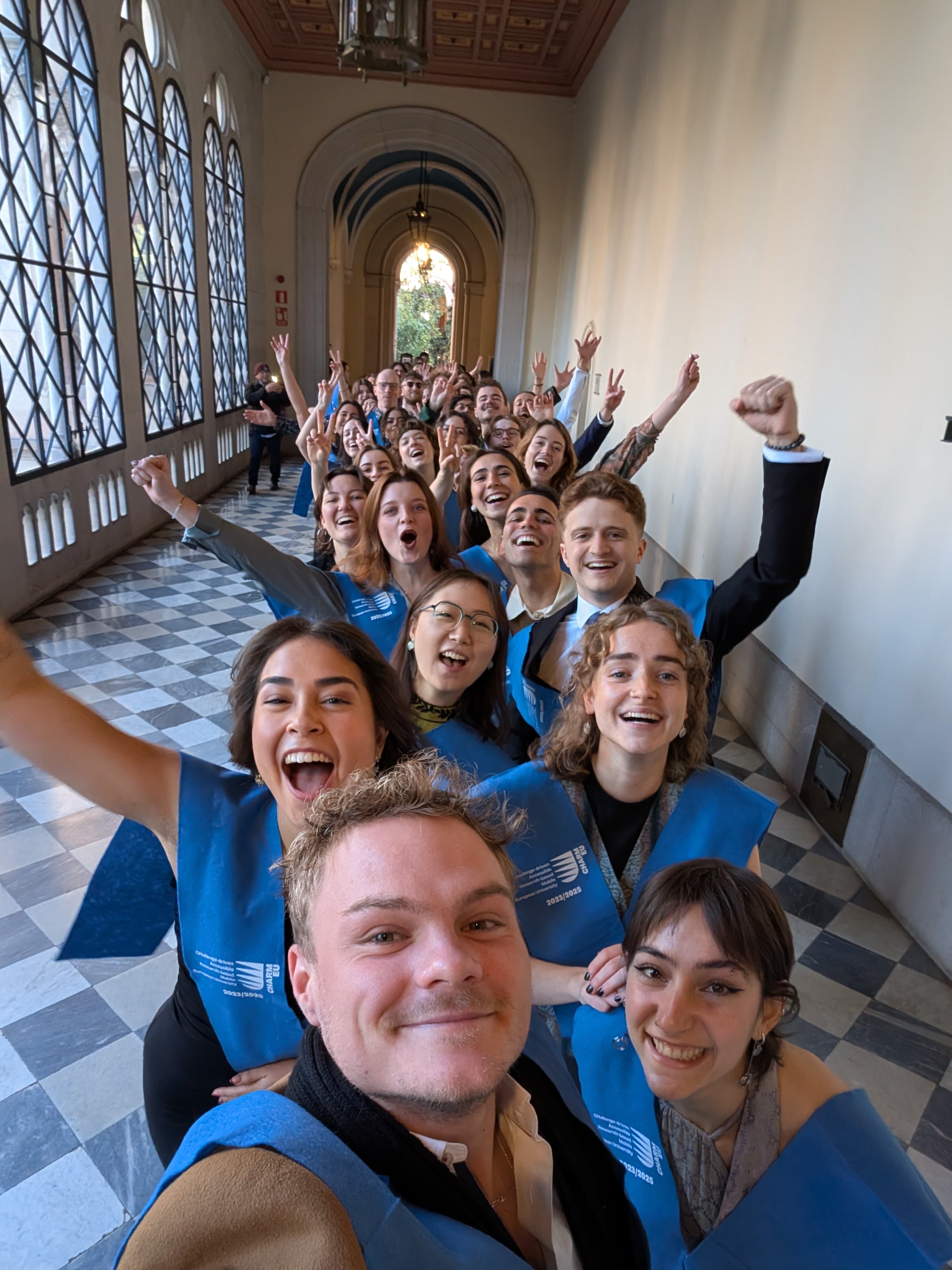
Our two-week blended intensive study trip was really exciting because it was the first time everyone was in the same place. By then, I had already met many of my peers in Barcelona and then in Montpellier, but the joint study trip was the first time we were all there together, it was a wonderful and uplifting experience. From an academic standpoint, I would highlight our second-semester project, where we explored the concept of virtual water and examined a festival as a case study for public education on the topic. This was very close to my heart, partly because I specialized in water, and partly because of my communication and marketing skills, which I was able to put to very good use here. I was able to channel my previously acquired knowledge into a sustainability project that was important from a social perspective. And we worked very well with the team, we received great feedback from our instructors. It was an important confirmation that I’m in the right place.
Given the transdisciplinary nature of the program, students in each group come from a wide variety of backgrounds and fields of study. What was it like to experience this diversity?
I really liked that, and ever since then I’ve been trying to reinforce the idea that it is a good thing when not everyone approaches a problem in the same way. Obviously, it wasn’t easy figuring out which perspective or angle each person was interested in, and which ones they’d be willing to work on. But in the end, everyone found their niche, and it was very exciting when we had to bring these different perspectives together and work on them. It was exciting to figure out how to weave them together, how to create a common solution. I really loved that, and ever since then I’ve been trying to emphasize that this is how we should work on problems.
What kind of project did you work on during the capstone phase?
For our capstone project, we collaborated with a company called Escuder. They are a B2B raw materials distributor company, and their main issue was packaging. They wanted to address this because they felt it was the only problem they didn’t know how to tackle. Then we came along and saw that they didn’t have a sustainability strategy, or any related planning. We ended up dealing not just with packaging, but with a whole lot of other things as well. I worked on B2B communication, for example, on how to communicate sustainability issues with their partners. We also worked on internal communication, on how to get the strategy accepted internally. It turned into a pretty complex project, and we were able to work very well with the company in a very pleasant, mutually supportive environment.
What are the most important knowledge, skills, or competencies you developed during the program?
Adaptation is definitely one of these. I adapt very quickly to new situations, new environments, and new challenges, because the program required me to do so across various locations, teams, and problems. I’ve continued to work this way ever since, juggling multiple projects at once with different companies, challenges, and teams, and I thrive in this environment. I’ve also improved a lot in teamwork and communication, for example, I’ve learned how to give and receive feedback effectively. Finally, I’d like to highlight self-reflection: we had to write a lot of self-reflections for the projects, which enabled us to examine our own work from a different perspective.
What projects have you worked on since completing the program?
I work with civil society organizations, such as the Water Coalition, which focuses on water-related issues. I help organize the Vegan Summit and produce educational materials on water-related topics. I assist the World Food Forum, which is one of the UN’s initiatives bringing young people together, and I work with a festival on water management and strategic sustainability issues. It’s interesting that before the MSc, I had never dealt with water, but as a result, I became closely involved with this topic and it became very much part of my work. Moreover, this topic is highly relevant in Hungary as well, because we’re already experiencing severe droughts, and we need to do something about it.
Who do you think should consider enrolling in the CHARM-EU master’s program?
I would basically recommend it to everyone, but you do need a certain mindset to thrive in this fast-paced problem-solving environment. The program is quite intensive both personally and professionally, so the ideal candidate should have a desire to be surrounded by this kind of fast-paced environment. I think this program is also great for anyone who is interested in sustainability but doesn’t know where to start. This program is very complex, and I think it opens up far more opportunities than a narrower specialization. I think it’s worth starting for those who are open to this and are looking for an intensive and exciting program.