


Researchers from Eötvös Loránd University (ELTE) and Semmelweis University have investigated what happens to horse chestnut leaves when they are attacked from within by the horse chestnut leaf miner. Their findings show that the functioning of the leaf changes while the damage is still barely visible to the naked eye. The results have been published in the journal Plant Stress.
The horse chestnut leaf miner (Cameraria ohridella) is a widespread pest of horse chestnut trees across Europe. The larvae feed inside the leaves, and as they consume increasingly large areas of tissue, the leaves turn brown and fall prematurely. The damage, however, begins much earlier: changes are already taking place in the leaf’s tissues and cells when there are barely any visible signs on the outside.
The findings provide a more detailed picture of how horse chestnut trees respond to leaf miner damage and what changes occur before visible symptoms appear. Detecting these early signs could in the future help identify damage sooner and improve the timing of plant protection measures.
What happens inside the leaf?
The invasive moth species, the horse chestnut leaf miner, was first described in North Macedonia in 1986 and has since spread across almost the whole of Europe. Its larvae create so-called mines inside horse chestnut leaves, where they feed on the leaf tissue. They primarily consume cells of the palisade parenchyma cells, a tissue layer located in the upper part of the leaf whose cells contain numerous chloroplasts, which play a key role in photosynthesis.
The researchers found that the damage is not limited to the tissue directly consumed by the larvae. Changes also occur in the leaf tissue surrounding the mines, even when these areas still appear healthy to the naked eye: the structure and functioning of cells and chloroplasts are altered, and photosynthetic activity decreases.
“We collected samples from horse chestnut trees in ten urban parks in Budapest and Szombathely between 2021 and 2025. We compared tissue from healthy, intact leaves with visually intact areas surrounding larval mines, as well as with leaf sections showing early- and late-stage damage,” explained Enkhjin Enkhbileg, PhD student and first author of the published paper.
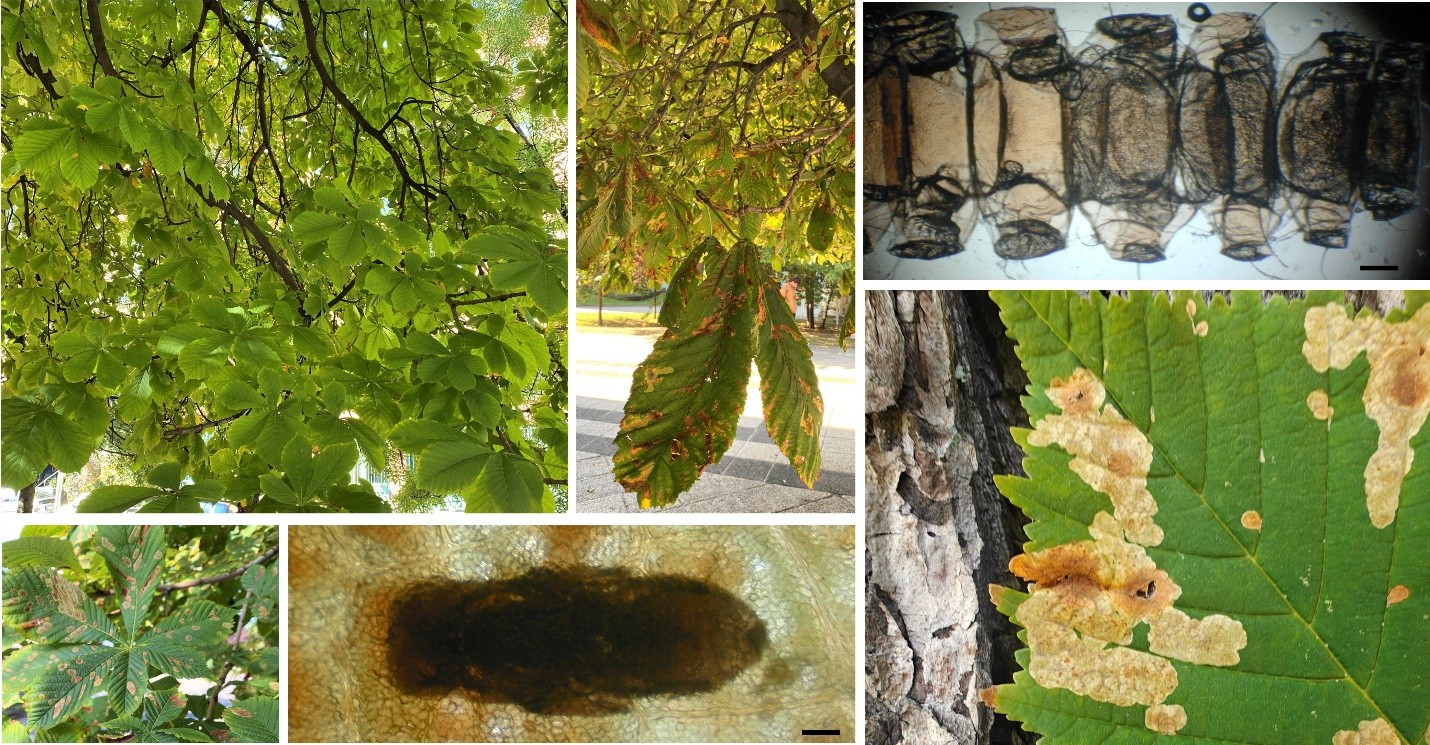
Assorted images of horse chestnut leaves showing different stages of leaf miner infestation, from healthy tissue and early mines to extensive brown, damaged areas. Light microscopy images show larvae inside the leaves, feeding within the leaf tissue (scale bar: 50 µm).
The leaf responds even when it still looks healthy
The changes in the surrounding leaf tissue are not limited to photosynthesis: the plant’s defence-related metabolism also changes in response to the presence of the larvae. Among other things, the researchers tracked changes in phenoloid metabolism. Some of the compounds involved play a role in protecting plants against environmental stress.
In damaged areas, the leaf gradually becomes less able to regulate water loss, causing the remaining tissue to dry out. This also damages the functioning of cells and chloroplasts involved in photosynthesis. Initially, the plant responds by activating defence processes, but as the larvae consume increasingly large areas of tissue, this defence response gradually becomes exhausted, and the remaining photosynthetic tissue also breaks down. Eventually, the leaf turns brown and falls prematurely.
Tracking the process with multiple methods
The research forms part of a larger project led by Katalin Solymosi, a researcher at the Department of Plant Anatomy and the Plastid Biology Laboratory of the Institute of Biology at ELTE. The researchers used microscopic analyses, together with measurements of photosynthesis and phenoloid metabolism, to track how the leaf changes at different stages of the damage.
One important finding was that some signs of damage can be detected before visible symptoms appear. Chlorophyll fluorescence imaging can reveal changes that are not yet visible to the naked eye.
“The research contributes not only to our understanding of one of the major pests of horse chestnut, but also to the early detection of stress in urban trees and leaf miner damage. Chlorophyll fluorescence imaging may make it possible to detect the presence of larvae at stages when the damage is still invisible to the naked eye,” said Katalin Solymosi, last author of the publication.
The possibility of detecting damage at an early stage could also help improve the timing of plant protection measures and, in the longer term, contribute to more targeted use of plant protection products.
Publicaion:
Enkhjin Enkhbileg, Éva Sárvári, Anna Skribanek, Imre Boldizsár, Katalin Solymosi (2026): Leaf miner (Cameraria ohridella) infestation drives progressive chloroplast degradation, thylakoid complex reorganization, and phenolic depletion in horse chestnut (Aesculus hippocastanum L.) leaves. Plant Stress 24, 101527.
DOI: 10.1016/j.stress.2026.101527